
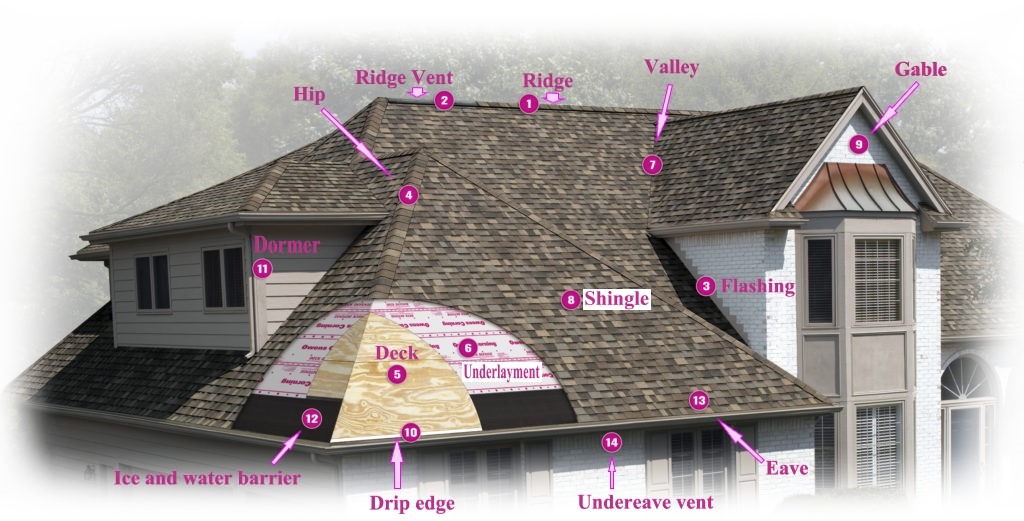
When you’re working with a roofing contractor in Middlesex County—whether you live in Highland Park, Edison, Metuchen, East Brunswick, Princeton, or Monmouth—you may hear industry-specific terms that sound unfamiliar. While you can always ask your roofer to explain, having a clear understanding of roofing terminology helps you feel confident when discussing inspections, repairs, or replacements.
This glossary covers the roofing terms Middlesex County homeowners encounter most during inspections and replacements. This complete list of roofing terms will come in handy when you plan for roofing or siding projects—covering shingles, roof structures, drainage, weather protection, and installation practices. It’s designed for homeowners in Central New Jersey who want to make informed decisions during roof repairs or replacements.

Why Roofing Terminology Matters
Roofing projects are major investments. Miscommunication can lead to delays, extra costs, or confusion. Understanding these roofing terms in Middlesex County helps you ask the right questions and avoid being overcharged. Additionally, by learning the most common roofing terms, you’ll be able to
- Ask the right questions during inspections.
- Understand your roof’s structure and materials.
- Communicate effectively with your contractor.
- Make informed decisions about repair vs. replacement.
Common Roofing Terms Explained — From Inspection to Replacement
1. Roofing Materials

- Asphalt: A bituminous waterproofing material applied to roofing materials during manufacturing.
- Architectural Shingles: Laminated shingles containing more than one layer to create extra thickness; also called three-dimensional shingles.
- Base Sheet: A product used as a base ply in self-adhering roll roofing systems.
- Cap Sheet: Mineral-surfaced material used as the top layer of rolled roof covering systems.
- Felt: Fibrous material saturated with asphalt, used as underlayment.
- Fiberglass Mat: Core material in asphalt shingles made from glass fibers.
- Granules: Ceramic-coated crushed rock applied to asphalt roofing products.
- Mineral Stabilizers: Finely ground inert materials (e.g., limestone, slate) added to asphalt.
- Mineral-Surfaced Roofing: Asphalt shingles/roll roofing covered with granules.
- Mid-ply Sheet: See Base Sheet.
- Roofing Tape: Asphalt-saturated tape used for flashing/patching.
- SBS (Styrene-Butadiene-Styrene): Polymer mixed with asphalt for flexibility.
- Underlayment: Asphalt-saturated felt or synthetic material beneath roofing.
- Release Tape: Plastic strip preventing shingles from sticking together in bundles.
2. Roofing Components & Accessories

- Bundle: A package of shingles (3–5 bundles per square).
- Collar (Vent Sleeve/Pipe Flashing): Flange over a vent pipe to seal around opening.
- Counter Flashing: Flashing attached to vertical surfaces to keep water out.
- Course: A row of shingles or roll roofing.
- Coverage: Number of material layers between surface and deck.
- Cricket: A peaked saddle at the back of chimneys to deflect water.
- Deck (Sheathing): The surface (plywood/OSB) installed over framing.
- Drip Edge: Material along eaves/rakes allowing water to drip clear of structure.
- Eave: Horizontal lower edge of a sloped roof. (See Figure B.)
- Flashing: Metal pieces preventing water seepage at roof intersections.
- Gutter: Trough channeling water to downspouts.
- Downspout (Leader): Pipe carrying water from gutters to ground.
- Hip: External angle where two sloping roof planes meet. (See Figure B.)
- Ridge: Uppermost horizontal angle where two roof planes meet. (See Figure B.)
- Rake: Inclined edge of a sloped roof. (See Figure B.)
- Soffit: Finished underside of the eaves.
- Soil Stack: Vent pipe penetrating the roof.
- Starter Strip: Asphalt roofing at the eave, adds protection at first course.
- Step Flashing: Flashing used where a vertical surface meets sloped roof.
- Tab: Exposed portion of strip shingles defined by cutouts. (See Figure A.)
- Valley: Internal angle where two roof planes meet. (See Figure B.)
- Vent: Outlet for air (pipe, stack, roof, gable, or soffit).
3. Roof Types & Structures
- Built-Up Roof (BUR): Flat/low-sloped roof with multiple asphalt layers.
- Dormer: Framed window projecting through a sloping roof.
- Gable: Upper triangular portion of a sidewall under a double sloped roof. (See Figure B.)
- Gambrel Roof: Two-slope roof per side; lower steeper than upper.
- Mansard Roof: Four-sided roof with steep lower slope, nearly vertical. (See Figure B.)
- Overhang: Part of roof extending beyond exterior walls.
- Rafter: Framing member sloping from ridge to wall plate.
- Rise: Vertical distance from eaves to ridge.
- Run: Horizontal distance from eaves to point under ridge.
- Shed Roof: Roof with a single sloping plane.
- Slope (Pitch): Roof incline ratio (rise/run).
- Span: Horizontal distance from eave to eave.
4. Roofing Methods & Construction Practices
- Blisters: Bubbles on asphalt roofing after installation.
- Caulk: Filler to seal joints and prevent leaks.
- Chalk Line: Taut string with chalk for alignment.
- Closed Cut Valley: Valley method where shingles overlap across valley.
- Nesting: Reroofing method fitting new shingles against old ones.
- Open Valley: Valley method where flashing is exposed.
- Ply: A roofing layer (one-ply, two-ply).
- Ponding: Water accumulation in roof low areas.
- Reroofing: Removing and replacing an existing roof.
- Shading: Color variations in shingles from manufacturing.
- Single Coverage: One material layer over the deck.
- Square: Roofing unit covering 100 sq. ft.
- Tear Off: Removing existing roofing down to deck.
- Telegraphing: Shingle distortion from uneven surfaces beneath.
- Top Lap: Covered portion of roofing in installation.
- Woven Valley: Valley method with shingles woven together, flashing not exposed.
5. Roof Performance Issues
- Ice Dam: Ice buildup at eaves forcing water under shingles.
- Ponding: Standing water after rainfall.
- Blisters: Bubbles in asphalt roofing surface.
- Telegraphing: Visible distortions caused by uneven substrates.
6. Measurement & Standards
- Square: Unit of measure = 100 sq. ft. of roof area.
- UL (Underwriters Laboratories, LLC): Independent testing and safety standards.
Source: Owens Corning Roofing Glossary
Local Insight: Why Homeowners in Middlesex County Should Know These Terms
In communities like Highland Park, Edison, and East Brunswick, older homes often need reroofing or updates to modern materials. Meanwhile, newer developments in Princeton and Monmouth may require architectural shingles, ice & water barriers, or advanced ventilation to prevent issues like ice dams in New Jersey winters.
By understanding this glossary, Middlesex County homeowners can confidently compare roofing quotes, understand the scope of work, and ensure their contractor uses proper materials and installation methods.
Need Help Understanding Your Roof in Middlesex County?
If you live in Highland Park, Edison, Metuchen, East Brunswick, Princeton, or Monmouth and want expert advice, our team at Eleven Exterior can walk you through your roofing project step by step. From explaining terminology to showing you material samples, we make sure every homeowner feels informed and comfortable before we begin work.
📞 Call us today at 201-800-5856 or click below to schedule your free roof inspection.
